

Unit Dose Packaging: From Clinical Trials to Commercial Launch
Why selecting a scalable unit-dose or unit-of-use blister platform early can simplify commercialization
Overview
- “Unit dose packaging” is often used as a broad search term for dose packs, blister wallets, and unit-of-use pharmaceutical packages.
- Changing packaging platforms late in development can introduce additional design, qualification, regulatory, and manufacturing work.
- Maintaining the same underlying dose-pack platform can reduce transition risks, even when artwork, labeling, materials, or configurations must change.
- Keystone offers clinical and commercial versions of the same child-resistant blister packaging platforms.
Searches for unit dose packaging do not always mean a single hospital-dispensed dose. Pharmaceutical teams also use the term when looking for a complete course of medication organized in a calendarized blister card, dose pack, or wallet. These formats are more precisely described as unit-of-use packaging because the package contains the prescribed quantity or treatment regimen in one patient-ready presentation.
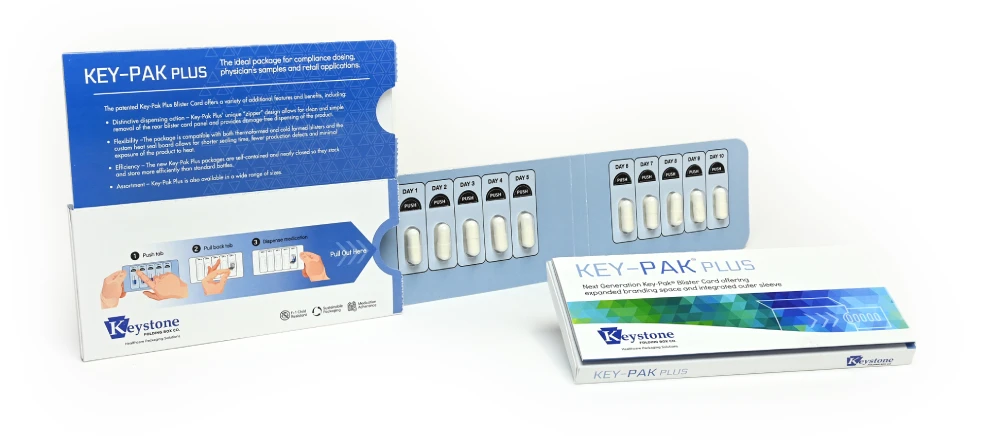
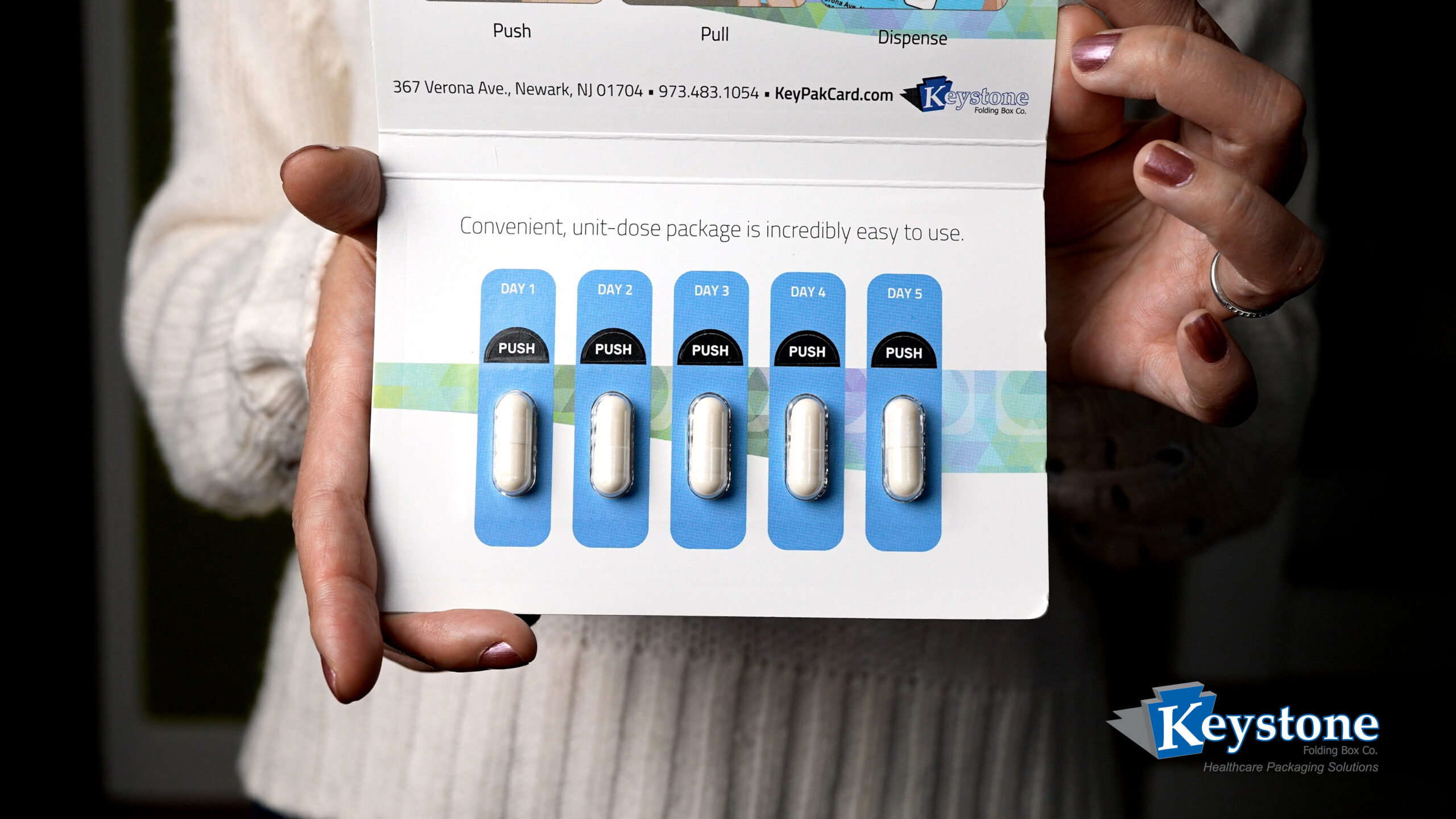
Keystone supports this broader market need with child-resistant paperboard blister wallets and dose-pack platforms such as Key-Pak and EcoSlide-Rx. Each blister cavity protects an individual dose, while the complete package can organize multiple doses into a unit-of-use regimen with instructions, calendarization, and space for required information.
The unit dose or unit-of-use packaging selected for a clinical trial can influence far more than the study itself. Early decisions about package architecture, blister configuration, patient access, dosing presentation, materials, and manufacturing can affect the work required as a product advances toward commercial launch.
Clinical and commercial packages are rarely identical. Clinical supplies may require blinding, randomization codes, booklet labels, protocol-specific instructions, and multiple country configurations. Commercial packages introduce their own branding, labeling, serialization, production-volume, and distribution requirements. However, the underlying packaging platform does not always need to change.
By selecting a scalable platform during clinical development, pharmaceutical manufacturers can preserve established package functionality and manufacturing knowledge while adapting the finished package for commercial requirements. Keystone supports this approach with clinical-trial unit dose and unit-of-use packaging and corresponding commercial pharmaceutical dose-pack solutions.
Unit Dose Packaging vs. Unit-of-Use Packaging
The terms overlap in everyday pharmaceutical packaging discussions, but they do not describe exactly the same thing.
| Term | More precise meaning | Common examples |
| Unit dose packaging | One measured dose individually packaged and identified for administration | A single blister cavity, strip-pack dose, pouch, vial, or ampoule |
| Unit-of-use packaging | The quantity or regimen intended to be dispensed to a patient as one complete package | Calendarized blister card, dose pack, titration pack, therapy wallet, or course-of-treatment package |
Someone searching for “unit dose packaging” may therefore be looking for either individually protected medication doses or a complete patient-ready package containing multiple individually organized doses. Key-Pak and EcoSlide-Rx address both aspects: medication is protected by individual blister cavities, while the paperboard package organizes the complete regimen into a practical unit-of-use presentation.
For pharmaceutical marketers, packaging engineers, clinical-supply teams, and CDMOs, identifying the intended use is more important than debating terminology. The package must ultimately support the medication, dosing regimen, patient population, child-resistance requirements, labeling, manufacturing process, and distribution environment.
What Packaging Continuity Really Means
Packaging continuity does not mean sending the exact clinical package directly into commercial production without review or modification. It means retaining the underlying package architecture wherever practical.
Elements that may remain consistent include:
- The blister layout and dose organization
- The child-resistant opening mechanism
- The way patients access individual doses
- The basic paperboard structure
- The package’s compatibility with the selected blister materials
- Core converting, sealing, and assembly principles
Other elements commonly change as a program advances:
- Clinical labels, booklet labels, and randomization information
- Commercial artwork, branding, and regulatory copy
- Serialization and traceability requirements
- Production quantities and manufacturing equipment
- Materials selected for stability, distribution, or market requirements
- Package dimensions or configurations needed for the final commercial presentation
Maintaining a proven platform gives project teams an established foundation. Every program must still be evaluated according to its product, market, regulatory, stability, validation, and manufacturing requirements.
The Cost of Changing Packaging Platforms Late
Moving from one packaging architecture to another after clinical development is more than a graphic change. A new format may require additional design work, specifications, tooling, samples, line trials, qualification activities, labeling development, supplier coordination, and manufacturing planning.
| Late change to a new packaging platform | Platform continuity from clinical development |
| New structural design and component specifications | An established package architecture to build upon |
| New tooling, setup, and manufacturing evaluation | Existing package and process knowledge retained |
| Revised patient-opening instructions | Familiar patient interaction where appropriate |
| New line trials and qualification planning | A clearer path for scale-up and technology transfer |
| New suppliers and component lead times | Greater continuity in component and supply planning |
| Additional project variables near launch | Fewer avoidable structural changes during commercialization |
Changing platforms may be necessary when the clinical format cannot meet commercial requirements. The objective is not to avoid every change; it is to avoid changes that provide no corresponding product, patient, regulatory, or manufacturing benefit.
Plan for Commercial Packaging During Clinical Development
Clinical packaging has an immediate objective: deliver the correct study medication according to protocol while protecting the product and supporting accurate use. Commercial packaging must also address market-specific labeling, branding, distribution, manufacturing efficiency, patient experience, and supply continuity.
Considering commercial requirements during clinical development helps teams determine whether the selected package has a credible scale-up path. Useful questions include:
- Can the package architecture support both clinical and commercial volumes?
- Will the blister configuration accommodate the anticipated dosing regimen and product presentation?
- Can clinical labeling be replaced with commercial graphics without redesigning the entire structure?
- Does the package provide the required level of child resistance and senior accessibility?
- Are the materials compatible with the product’s stability and distribution requirements?
- Can the platform run on available or planned packaging equipment?
- What tooling, qualification, validation, and technology-transfer activities could be required at scale?
- Can the supplier support clinical quantities, launch volumes, and continued commercial demand?
Addressing these questions early creates a more informed clinical-to-commercial packaging strategy and helps packaging, clinical supply, regulatory, operations, and sourcing teams plan around the same long-term objective.
Child-Resistant Unit Dose Packaging Platforms Designed to Scale
Keystone develops child-resistant unit dose and unit-of-use packaging platforms in clinical and commercial versions. These paperboard blister wallets and pharmaceutical dose packs allow sponsors to retain the fundamental patient interaction and package architecture while adapting labeling, graphics, materials, and production processes for the next stage of the product lifecycle.
Key-Pak F1 Wallet Card
The Key-Pak F1 Wallet Card combines F=1 child-resistant performance with individually protected doses and a large printable area for dosing instructions and required information. The platform can accommodate standard tablets and capsules as well as more challenging dosage forms and complex regimens.
For a clinical-to-commercial program, the blister arrangement and child-resistant functionality can provide a consistent foundation while the outer graphics and information architecture evolve from study-specific content to the final commercial presentation.
Ecoslide-Rx Reclosable CR Pack
The EcoSlide-Rx reclosable child-resistant package accommodates a range of tablet and capsule sizes in a paperboard-based format. Its reclosable design supports repeated access while maintaining F=1 child-resistant performance.
Clinical and commercial versions allow manufacturers to evaluate the platform during development and carry the same basic packaging approach forward when it remains appropriate for the approved product and commercial supply strategy.
Benefits Across the Product Lifecycle
A continuous packaging platform can create value for multiple functions.
Packaging and Engineering
Teams retain knowledge about package construction, patient access, components, sealing, and assembly rather than beginning with an unfamiliar structure near launch.
Clinical Supply
A platform suited to protocol-specific dosing and labeling can support the study while giving the team visibility into potential commercial applications.
Manufacturing and Technology Transfer
An established package architecture provides a more defined starting point for equipment evaluation, line trials, scale-up, and process qualification.
Regulatory and Quality
Reducing unnecessary structural changes can limit the number of new variables that must be assessed and documented. Specific regulatory, validation, stability, and quality requirements still depend on the product and proposed changes.
Sourcing and Supply Chain
Early visibility into components, materials, tooling, suppliers, and anticipated volumes can improve launch planning and reduce avoidable sourcing changes late in development.
Patients
Where appropriate, preserving dose organization and package operation can maintain a patient interaction already used during the clinical program.
A Practical Clinical-to-Commercial Packaging Checklist
Before selecting a clinical unit-dose package, confirm that the team has considered:
- Clinical dosing and calendarization requirements
- Blinding and study-label requirements
- Child-resistant and senior-friendly performance
- Patient opening and dispensing instructions
- Product protection and stability requirements
- Anticipated commercial dose count and presentation
- Commercial artwork and information space
- Serialization and traceability needs
- Clinical, launch, and ongoing production volumes
- Equipment, sealing, and assembly compatibility
- Tooling, qualification, and validation planning
- Component sourcing and lead times
- Geographic and market-specific requirements
- Second-source and supply-continuity strategies
The answers may not be final during early development. Identifying them early, however, helps teams avoid treating commercial packaging as an entirely new project after the clinical program is complete.
Build Packaging Continuity into the Development Plan
Packaging decisions made during clinical development do not have to end when the study does. Selecting a scalable platform early can preserve established package functionality, reduce avoidable redesign, and create a more predictable starting point for commercial planning.
The same finished package will not always move unchanged from a clinical trial to the market. Artwork, labeling, materials, production methods, and regulatory requirements may evolve. The opportunity lies in maintaining a proven underlying platform when doing so supports the product, patient, and manufacturing strategy.
Keystone offers clinical and commercial versions of its child-resistant unit-dose platforms, giving pharmaceutical manufacturers a consistent foundation from study packaging through launch. Connect with Keystone to evaluate a clinical-to-commercial packaging platform for your product.
Frequently Asked Questions
What is unit dose packaging?
Unit dose packaging contains one measured dose in an individually protected package, such as a blister cavity, strip-pack dose, pouch, vial, or ampoule. The term is also commonly used by pharmaceutical buyers searching for calendarized blister cards and dose packs that organize multiple individually protected doses.
What is the difference between unit dose and unit-of-use packaging?
Unit dose packaging refers more precisely to one individually packaged dose. Unit-of-use packaging contains the quantity or complete regimen intended to be dispensed to one patient, such as a calendarized blister wallet, titration pack, or course-of-treatment package. A unit-of-use package may contain multiple unit doses.
Are Key-Pak and EcoSlide-Rx unit dose or unit-of-use packages?
They combine characteristics of both. Individual blister cavities protect and organize separate doses, while the complete paperboard wallet can present a multi-dose regimen as a patient-ready unit-of-use package.
Can a clinical-trial blister package be scaled for commercial production?
It may be possible when the underlying platform supports the required commercial dose count, materials, child-resistant performance, labeling area, equipment, and production volumes. Commercialization still requires a program-specific assessment of regulatory, stability, validation, quality, and manufacturing requirements.
Does packaging continuity mean the clinical and commercial packages are identical?
No. Packaging continuity generally means preserving the underlying platform or architecture. Clinical labels, randomization information, artwork, branding, serialization, materials, dimensions, and production processes may change for the commercial product.
Which packaging elements can remain consistent after clinical development?
Depending on the program, the blister layout, dose organization, child-resistant mechanism, patient-opening sequence, paperboard structure, and core sealing principles may remain consistent. Each element must be reviewed against the final commercial requirements.
When should commercial packaging requirements be considered?
Ideally, commercial requirements should enter the discussion during clinical packaging selection. Early planning helps teams understand whether the chosen format can scale and what changes, tooling, qualification, and supply-chain work may be required before launch.
How can child-resistant packaging affect the clinical-to-commercial transition?
Selecting an established child-resistant platform during clinical development can provide a proven structural foundation for the commercial package. The final configuration must still be evaluated for the intended product, market, users, and applicable testing requirements.
Can the same blister layout be used with different clinical and commercial artwork?
Often, the underlying blister arrangement can remain consistent while the printed components change. Feasibility depends on the required labeling, branding, regulatory information, dose instructions, package dimensions, and production process.
Latest Articles
While Keystone continues to be a leader in the manufacturing and design of paperboard packaging, they are also a design center and source for non-paperboard packaging components. To learn more about Keystone Folding Box Company, please contact Ward Smith at Keystone Folding Box Company, at (513) 871-4747, ward.smith@keyboxco.com or visit www.keyboxco.com.