


Why Cold-Seal Wallet Cards Are Not Suitable for Child-Resistant Blister Packaging
When pharmaceutical companies select blister wallet packaging, the decision is not only about branding or convenience — it is about patient safety, regulatory compliance, and proven child-resistant performance. In the United States, child-resistant (CR) packaging requirements are among the most stringent in the world. These standards demand packaging systems that deliver repeatable, verified protection against unintended access by young children, while still remaining usable for seniors.
Cold-seal wallet cards are not considered a suitable solution when true child resistance is required under U.S. protocol standards. Cold-seal blister wallets consistently fail to meet F=1 child-resistant requirements, while heat-sealed solutions such as Key-Pak® and Key-Pak Plus™ are used for pharmaceutical packaging programs that require verified CR performance.
Understanding Child-Resistant Requirements in the U.S. Market
Child-resistant packaging in the United States is governed by the Poison Prevention Packaging Act and enforced through protocols such as 16 CFR §1700.20 under the Consumer Product Safety Commission.
To meet compliance, packaging must pass third-party protocol testing and demonstrate that:
• Children under five cannot access the product within a defined time period
• Adults and seniors can still open the package appropriately
• The child-resistant feature remains functional over multiple openings
The highest level of certification is often referred to as an F=1 rating, representing full child-resistant compliance under protocol testing.
These requirements make seal integrity a critical factor in blister wallet design.
What F=1 Child-Resistant Protocol Testing Means
In the United States, the term child-resistant has a specific regulatory meaning. Child resistance is not a design claim or a theoretical feature. It is a performance classification demonstrated through formal protocol testing conducted under Consumer Product Safety Commission standards. One of the highest levels of child-resistant qualification is commonly referred to as an F=1 rating. An F=1 designation indicates that a packaging system has successfully met the full requirements of child-resistant protocol testing under 16 CFR §1700.20.
Key elements of F=1 protocol testing include:
- Regulatory enforcement and penalties
Packages are evaluated in controlled studies with groups of children under five years old. The protocol measures whether children can gain access to the drug product within strict time limits.
- Regulatory enforcement and penalties
Packaging must remain senior-friendly. The protocol includes testing with adults, including older adults, to confirm usability.
- Regulatory enforcement and penalties
For reclosable systems, performance must remain intact over multiple openings.
- Regulatory enforcement and penalties
A package cannot pass protocol testing if children can bypass the intended opening feature by peeling layers apart or separating adhesive bonds. This is the fundamental reason cold-seal wallet cards are unsuitable for child-resistant applications.
- Regulatory enforcement and penalties
Child-resistant compliance is outcome-based. Even if a design appears robust, the only meaningful measure is protocol testing success.
The Problem with Cold-Seal Wallet Cards
Cold-seal wallet cards rely on pressure-sensitive adhesive layers that bond when pressed together. While cold-seal construction allows for low-temperature assembly, it introduces a fundamental structural limitation. Cold-seal bonds are not permanent. According to leading child-resistant testing centers, no cold-seal blister wallet product has successfully passed F=1 child-resistant protocol testing.
This failure is driven by structural vulnerability. Cold-seal constructions can be peeled apart, allowing access without engaging the intended opening feature. Unlike permanent heat-sealed bonds, cold-seal adhesive interfaces remain susceptible to separation, particularly at edges and corners. These peel points create a direct pathway for children to bypass the child-resistant mechanism. Cold-seal wallet cards may be acceptable for non-child-resistant applications, but they are not appropriate in packaging programs where regulatory child resistance is required.
Market Risks Without Verified Child-Resistant Compliance
Child-resistant performance cannot be assumed. It must be demonstrated through protocol testing.
Launching pharmaceutical products in packaging that has not passed Consumer Product Safety Commission protocol requirements introduces regulatory, legal, and commercial risk.
These risks include:
- Regulatory Enforcement and Penalties
The Consumer Product Safety Commission has authority to enforce the Poison Prevention Packaging Act. Non-compliant packaging may result in civil penalties or corrective action. - Product Recall Exposure
Failure to meet protocol requirements can lead to voluntary or mandatory recalls. - Liability and Legal Exposure
Packaging failures increase liability risk in cases of accidental pediatric ingestion. - Pharmacy and Distribution Rejection
Non-compliant packaging may be rejected by wholesalers and retail pharmacies. - Reputational Damage
Child-safety failures can permanently damage brand trust.
Heat-Sealed Wallet Cards and the Keystone Difference
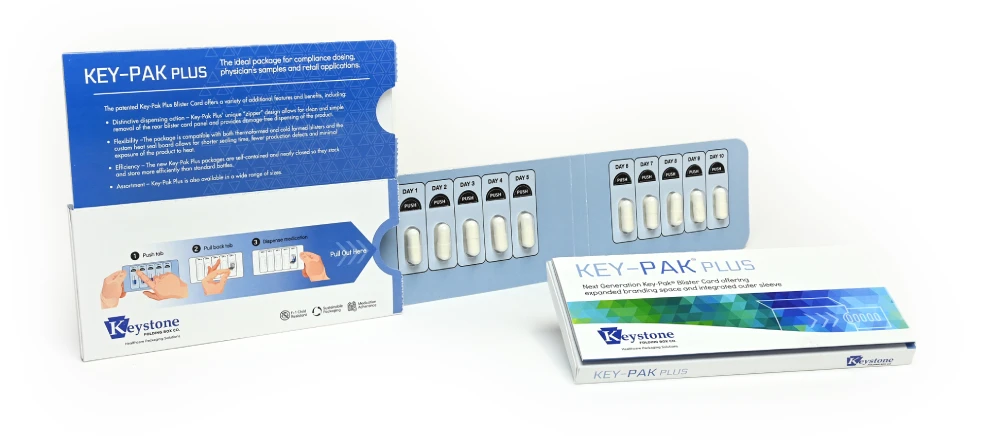
Keystone’s child-resistant blister wallet platforms, including Key-Pak® and Key-Pak Plus™, are built around permanent heat-sealed construction designed to support verified child-resistant performance. Heat-sealed wallet cards form durable, non-peelable bonds that maintain structural integrity throughout protocol testing and repeated use.
To achieve this without unnecessary thermal exposure, Keystone uses low-temperature hot melt sealing technology. This approach delivers permanent bonding while protecting the drug product and supporting efficient, scalable production. The result is a sealing method that meets child-resistant functional requirements while remaining compatible with high-volume pharmaceutical packaging operations.
Key-Pak® and Key-Pak Plus™ Platforms for Child-Resistant Blister Packaging
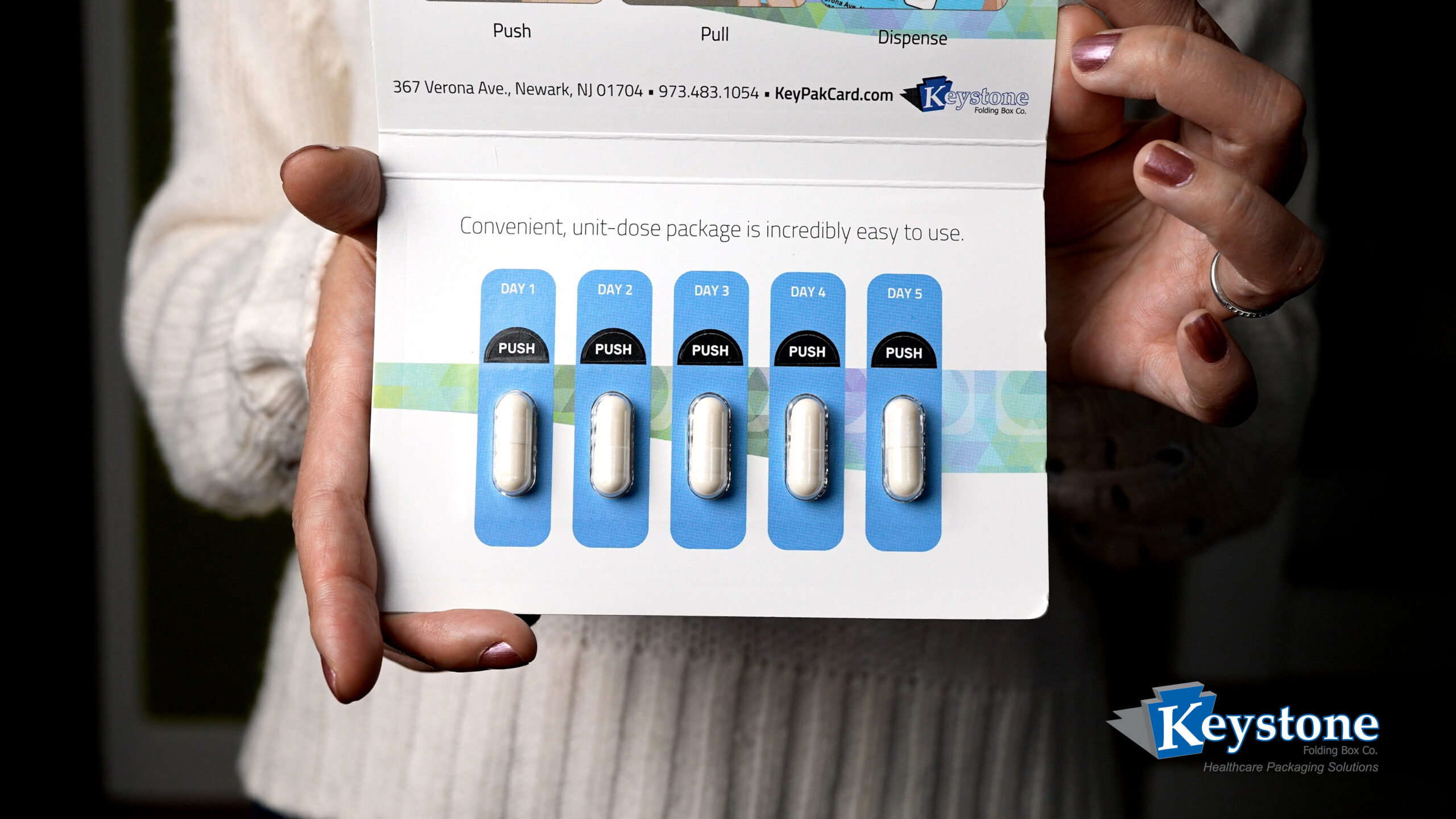
Keystone’s blister wallet platforms are designed to support verified child-resistant performance while remaining practical for real-world pharmaceutical use. These systems balance protocol-tested child resistance with senior-friendly access, durable sealed construction, and production scalability aligned with commercial requirements and U.S. regulatory expectations.
Available formats include Key-Pak® for outpatient child-resistant blister packaging and Key-Pak Plus™ for multi-dose adherence applications that require maintained child-resistant integrity. Additional formats such as Push-Pak® and Ecoslide-Rx® support senior-friendly compliance and reclosable child-resistant designs where appropriate.
Partner with Keystone for Child-Resistant Blister Packaging
Keystone provides child-resistant blister wallet packaging engineered to meet U.S. protocol requirements through permanent heat-sealed construction. Programs that require verified F=1 child-resistant performance rely on proven blister wallet platforms designed to maintain structural integrity throughout testing and use. If your program requires true child-resistant blister performance, we invite you to connect with Keystone to evaluate proven solutions.
Disclaimer: This content is provided for general informational purposes only and does not constitute legal or regulatory advice. Child-resistant compliance must be confirmed through qualified protocol testing and regulatory review.
Latest Articles
While Keystone continues to be a leader in the manufacturing and design of paperboard packaging, they are also a design center and source for non-paperboard packaging components. To learn more about Keystone Folding Box Company, please contact Ward Smith at Keystone Folding Box Company, at (513) 871-4747, ward.smith@keyboxco.com or visit www.keyboxco.com.